Convert Transmission to Absorbance (Extinction)
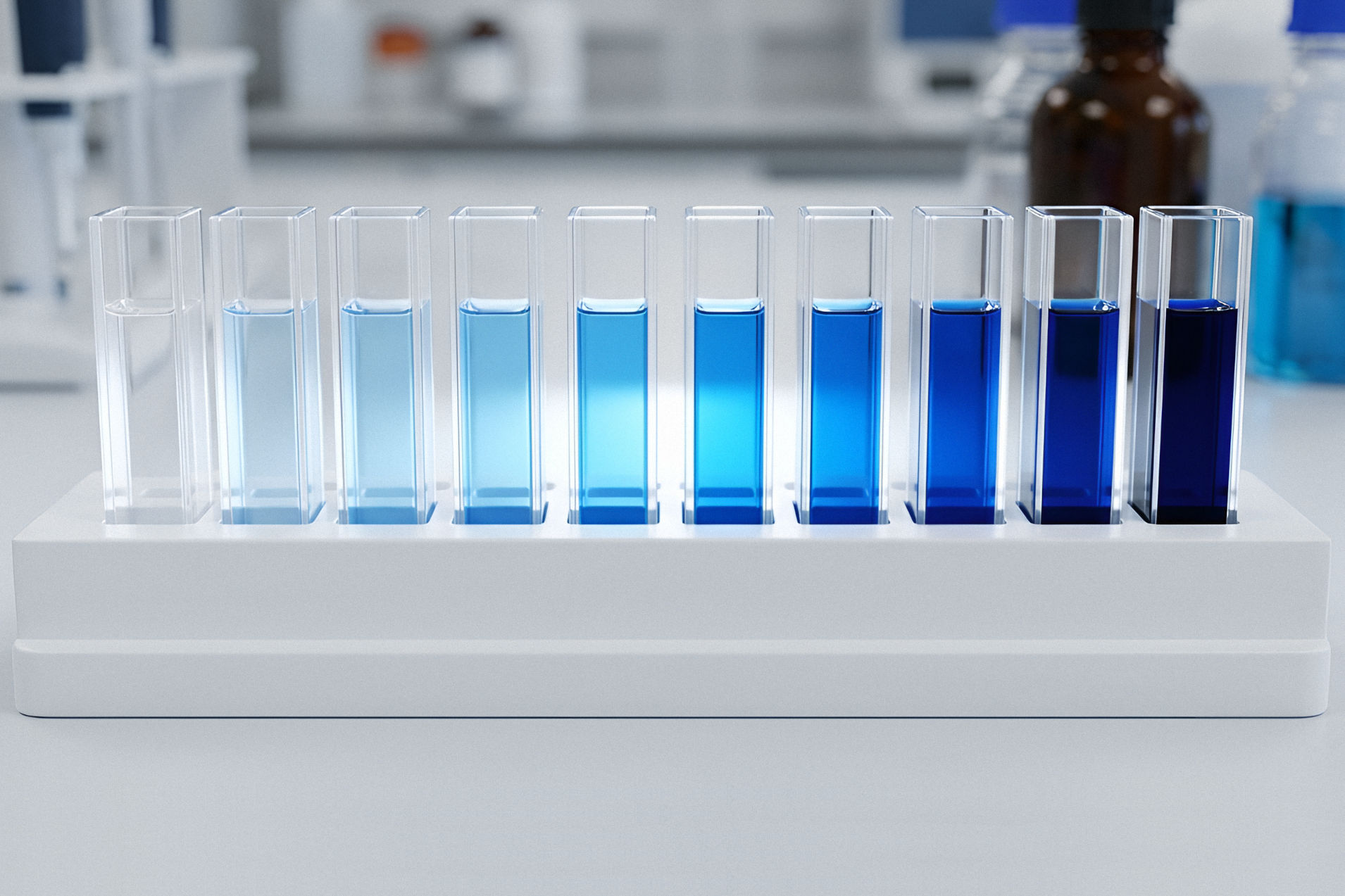
Unit Converter for Transmission and Absorbance (Extinction)
Transmission, Absorbance, and Extinction: Three Terms for the Same Measurement?
Anyone who works with a spectrometer encounters all three terms constantly, and it isn't always immediately clear how they relate. Yet the relationship is simple: transmission tells you how much light passes through the sample, and absorbance (or extinction) tells you how much light the sample has swallowed. The only difference is a logarithmic scale.
Transmission: The Direct Measurement
Transmission \(T\) is what the spectrometer physically measures. A light beam of intensity \(I_0\) strikes the sample; only the attenuated intensity \(I\) arrives on the other side. The ratio is the transmission:
\(T = \frac{I}{I_0}\)
Transmission is often expressed as a percentage: \(T[\%] = \frac{I}{I_0} \cdot 100\). A transmission of 100% means the sample is completely transparent at that wavelength, the light passes through unhindered. 0% transmission means no light gets through at all. In practice, useful measurements typically fall between about 0.1% and 100% transmission; below that, the signal is buried in detector noise.
Absorbance: The Logarithmic Perspective
Transmission has a drawback: it is not linear with concentration. Doubling the concentration of an absorbing substance does halve the transmission, but that is an exponential relationship, not a simple linear one. For quantitative analysis, this is impractical.
That is why transmission is converted logarithmically. The resulting quantity is called absorbance \(A\) (often also extinction \(E\) or OD, Optical Density):
\(A = -\log_{10}\left(\frac{I}{I_0}\right) = -\log_{10} T\)
Expressed as a percentage: \(A = -\log_{10}\left(\frac{T[\%]}{100}\right)\)
Converting back from absorbance to transmission: \(T[\%] = 100 \cdot 10^{-A}\)
The Difference Between Absorbance and Extinction
In everyday lab work, the terms absorbance and extinction are often used interchangeably, and for clear, non-scattering solutions this is perfectly fine. Physically, however, there is a subtle difference:
-
Absorbance describes exclusively the light attenuation caused by true absorption: the molecule takes up the photon energy, an electron jumps to a higher level or a vibration is excited. Only this portion is converted into the molecule's internal energy.
-
Extinction (from Latin exstinguere = to extinguish) is the broader term. In addition to true absorption, it includes all other effects that weaken the light beam, primarily scattering from particles or turbidity in the sample. For turbid samples, the measured extinction is therefore higher than the pure absorbance.
In practice, this distinction is especially relevant when samples are not clearly filtered (as in some process measurements) or when scattering itself carries the information of interest (as in NIR spectroscopy of powders or turbid liquids). For this reason, pharmacopoeias generally use the term "extinction", since it covers the more general case.
Understanding the Logarithmic Scale
Because absorbance is logarithmically related to transmission, equal steps in absorbance correspond to very different jumps in transmission. Some reference values:
| Transmission T [%] | Absorbance A | Meaning |
|---|---|---|
| 100 % | 0.000 | Completely transparent sample |
| 50 % | 0.301 | Half as much light as without the sample |
| 10 % | 1.000 | Only one tenth of the light remains |
| 1 % | 2.000 | Only one hundredth |
| 0.1 % | 3.000 | Only one thousandth, measurement limit for many instruments |
An \(A\) of 1 therefore does not mean "half", but 10% residual light. An \(A\) of 3 already corresponds to 0.1% transmission, at which point many spectrometers reach the end of their useful range because the signal is lost in detector noise. Modern spectrometers with good electronics and high-quality detectors can often reach values up to \(A \approx 3.5\) before noise dominates. A signal-to-noise ratio of 10,000:1, as offered by the Spektralwerk 15 Core NIR, means physically that the detector can still resolve a signal that is only one ten-thousandth of the maximum light flux. Converted, that corresponds to a transmission of 0.01% or \(A = 4\) at the theoretical detection limit. In practice, a safety margin above the noise floor is needed, so the useful upper limit is about \(A = 3.5\).
Why Logarithmic at All?
The decisive advantage of the absorbance scale: under ideal conditions, it behaves linearly with concentration. That is the statement of the Beer-Lambert law:
\(A = \varepsilon \cdot c \cdot d\)
Double the concentration \(c\) means double the absorbance \(A\) (with the same cuvette path length \(d\) and the same molar extinction coefficient \(\varepsilon\)). You simply couldn't calculate that easily with transmission. This is precisely why UV spectrometers and NIR spectrometers use the absorbance/extinction scale whenever quantitative information is needed.
Which Scale is Useful When?
In measurement reports and publications, absorbance is the measure of choice. It allows direct comparison between different concentrations and is the foundation of every calibration curve. Transmission, on the other hand, is more commonly found in technical specifications, such as when describing an optical filter ("transmission > 90% at 850 nm") or evaluating the efficiency of a monochromator.
A practical tip from the lab: when developing a new method, make sure the measured absorbance falls in the range of about 0.2 to 2.0. Below 0.2, the measurement becomes imprecise because the difference between sample and reference is barely measurable. Above 2.0, so little light reaches the detector that noise distorts the measurement. Choosing the right cuvette path length (\(d\)) and, if necessary, diluting the sample help keep measurements within this optimal range.
Spektralwerk Core NIR Spectrometer
| Feature | Spektralwerk 15 Core NIR |
|---|---|
| Wavelength range | 900-1700 nm |
| Detector array | InGaAs, 256 pixels |
| Signal-to-noise ratio (SNR) | up to 10000:1 |
| Sample rate / spectra per second | > 500 Hz (streaming mode) |
| Trigger in and trigger out | yes |
| Spectral resolution (FWHM) | 3.9 nm (Hg line at 1014 nm) 5 nm (Hg line at 1529.6 nm) |
| Interfaces | Ethernet, FC (SMA on request) |
| Operating temperature | -5°C to +30°C |
| Ingress protection | IP40 (higher on request) |
| Details | Learn more |
Looking for an NIR spectrometry solution?
Thank you for your message!
We will get back to you as soon as possible.
Unfortunately, we were unable to transmit your message.
A technical error occured. Please try again later — or send an email to sales@silicann.com.
Thank you for your understanding.
You might also like


AI-Assisted Development for Spektralwerk Spectrometers
The Spektralwerk API documentation is now available as an MCP server. This facilitates AI-assisted development, particularly in security-conscious companies.